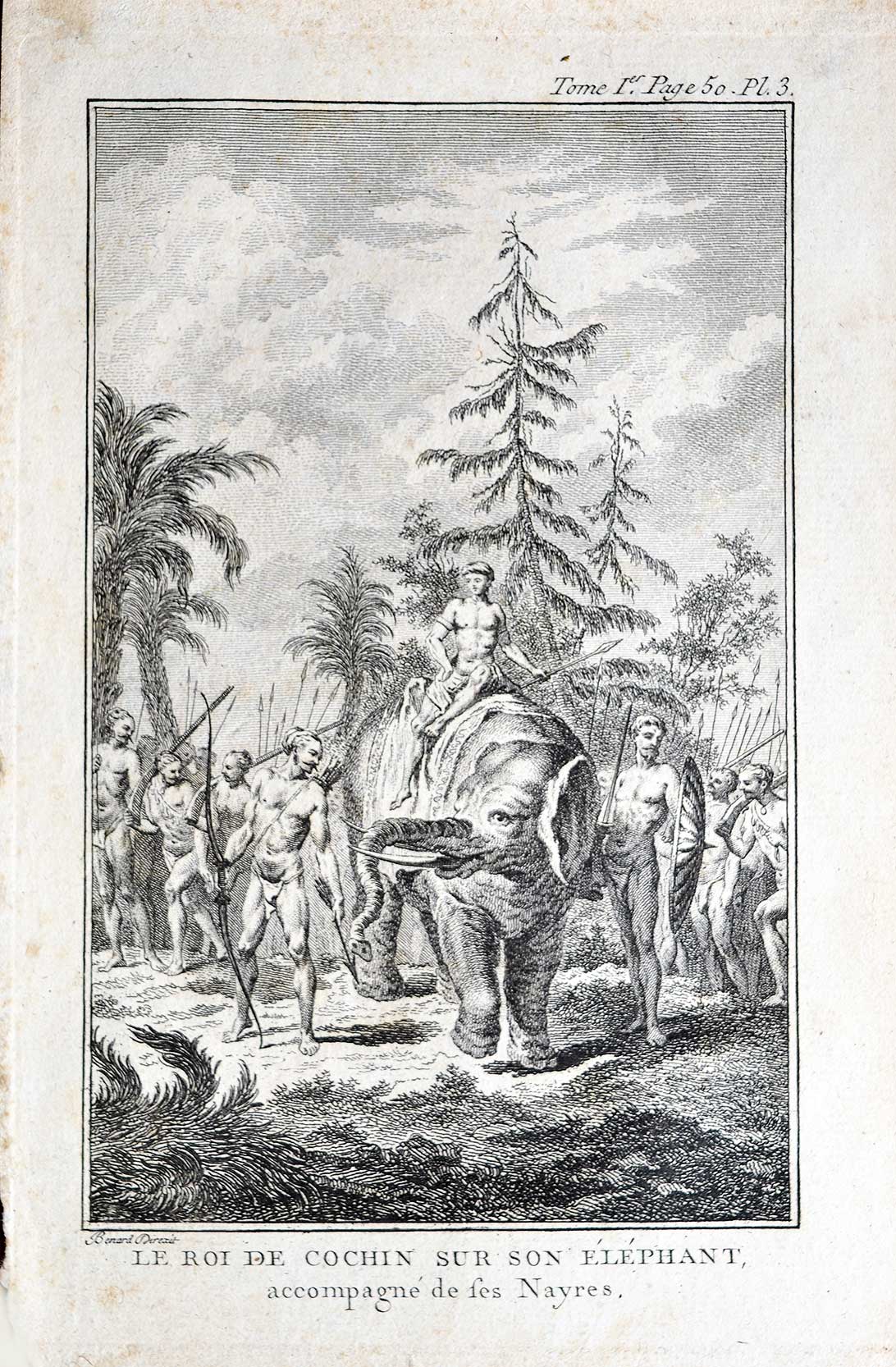
The King of Cochin on his Elephant, accompanied by his Nairs, 1750 Engraving
This copperplate engraving, dated to around 1750, depicts the King of Cochin (Kochi, Kerala) riding an elephant while being escorted by his Nairs, the traditional warrior nobility of the Malabar Coast.
Elephants were powerful symbols of royalty, military strength, and ceremonial authority. In the Kingdom of Cochin, elephants played a prominent role in state processions, religious festivals, and royal appearances. Making them an enduring emblem of Kerala’s cultural heritage even today. The armed attendants shown carrying bows, spears, and shields reflect the disciplined Nair warrior class, who served as soldiers, palace guards, and administrators under the Cochin rulers.
The scene shows the Raja of Cochin, ruler of a small but important kingdom on the Malabar Coast (present-day Kerala), mounted on an elephant. He is flanked by his Nairs, the disciplined warrior class who served as traditional soldiers, royal bodyguard, and administrators under the Cochin Rulers. They are shown here armed with bows, spears, and swords.
Interestingly, several of the Nair warriors are depicted carrying long gun firearms, probably matchlock muskets, with two visible on the left and one on the right. Such early European engravings showing armed Nair soldiers with firearms are relatively uncommon and provide an intriguing glimpse into the military transition taking place in India during the period. Cochin had been a magnet for European traders since the Portuguese established a fort there in 1503, making it one of the earliest and most enduring points of contact between India and the West. Click image to enlarge.
Did you know – the Nairs of Kerala were traditionally a matrilineal community, where descent and inheritance passed through the female line. It genuinely puzzled many European travellers, missionaries, and colonial officials, especially from the 16th to the 18th centuries.