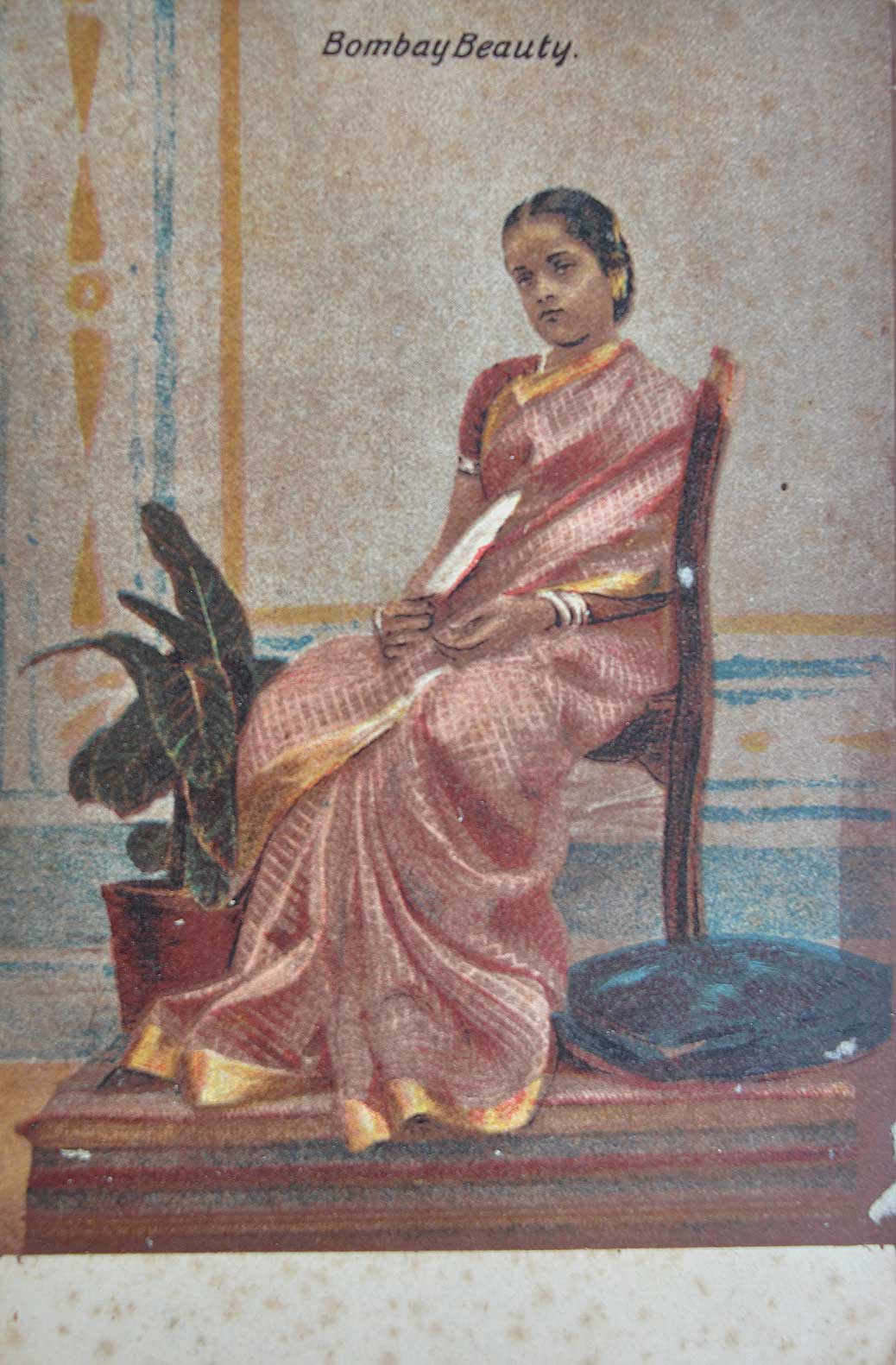
Rajibai Mulgaonkar: The Model Behind Ravi Varma’s Paintings, 1900 Postcard

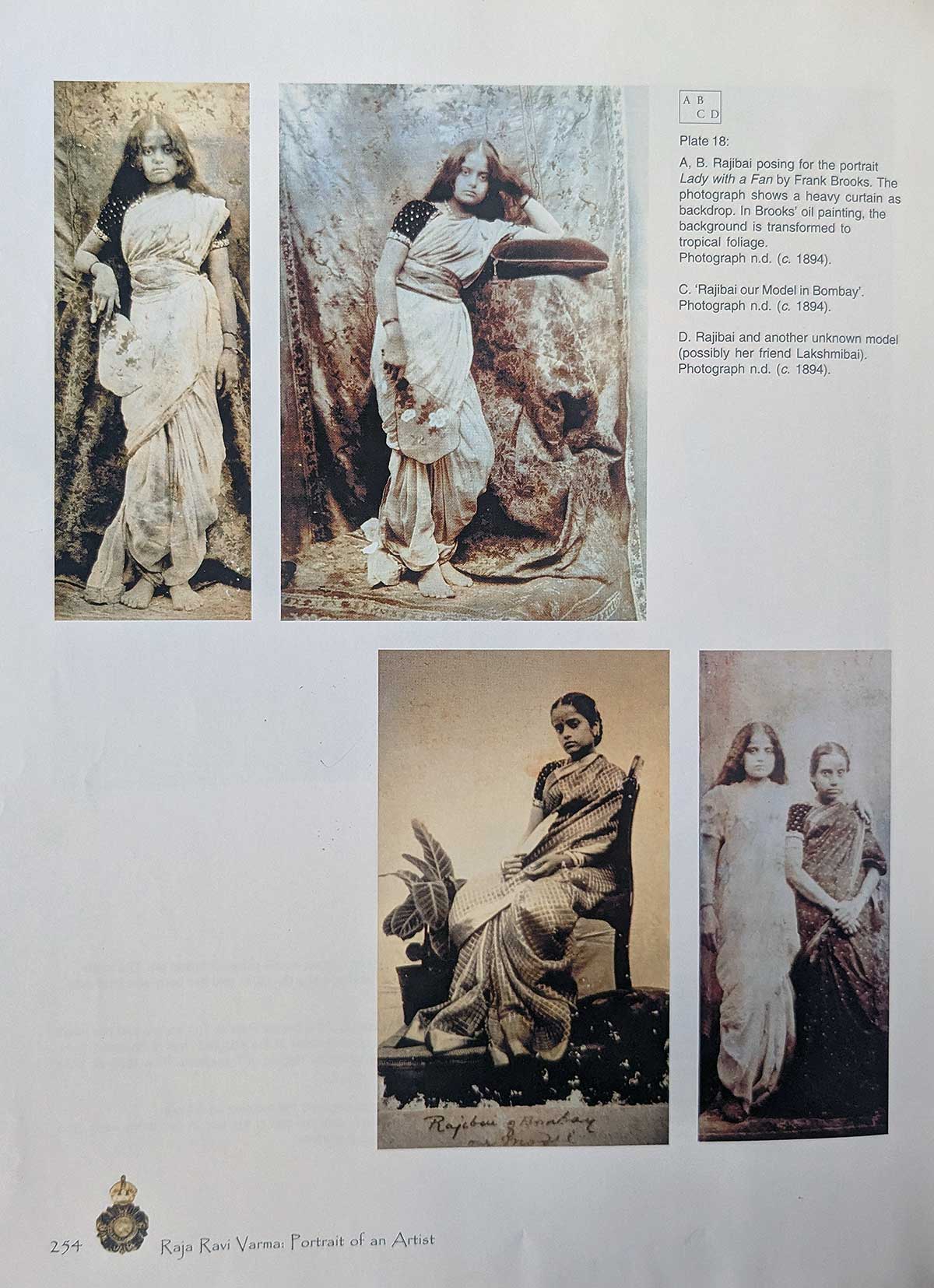
Among the many women who appeared in the paintings of Raja Ravi Varma, few are as intriguing as Rajibai Mulgaonkar. A young woman from Bombay (Mumbai) who became one of the artist’s important photographic models. The above picture is a reference from a book. Her story offers a fascinating glimpse into how Ravi Varma worked. And how photography was quietly transforming Indian art in the late 19th century.
Photographs were more than simple portraits: they became working references for Ravi Varma. He used images of Rajibai while developing figures such as Lakshmi and Ahalya. Rajibai was also associated with the modelling for the painting Lady with a Fan. She appears to have belonged to the Moolgavkar/Mulgaonkar family, a Goan family associated with the Kalavant tradition.
She was acquainted with Raja Ravi Varma and became a regular model at their Bombay studio. Research surrounding Ravi Varma suggests that her family had a personal connection with the artist, with Ravi Varma having painted a portrait of her father before Rajibai herself began posing for him.
Instead of seeing only an idealised goddess or heroine on canvas, we can glimpse the actual woman whose features and poses helped the artist construct those images. Ravi Varma was not dependent entirely on live sittings. Photography became an important tool in his artistic process, particularly when working in Bombay. This was enormously helpful because suitable female models were difficult to find, and social conventions made prolonged posing problematic. A photograph solved several of these problems.
A model could be photographed in a carefully arranged pose, and the image could then be studied repeatedly while the artist worked on his artwork. For Ravi Varma, this meant that a single sitting could potentially provide material for several compositions.
For Lakshmi, Saraswati, Ahalya and other female figures, the starting point could therefore be a real woman photographed in his studio. While the finished painting represented an idealised divine or literary character. Ravi Varma softened and transformed individual features so that the final image was not simply a portrait of the model. One of the most fascinating examples is the connection between Rajibai’s photographs and Ravi Varma’s paintings of Lakshmi and Ahalya.
Rajibai was not simply a model for one painting. Researchers and writers have connected her appearance with several works associated with Ravi Varma. Including Hamsa Damayanti and Shakuntala Looking Back, while other accounts have suggested that she may also have been the woman represented in the artist’s Milkmaid.
Ravi Varma’s years in Bombay were crucial to this transformation. From the 1890s onward, Bombay became an important base for the artist. The city exposed them to European art publications, photographers, professional artists, and new technologies.
In 1894, Ravi Varma’s Fine Arts Lithographic Press began operating. The press employed European specialists, including Fritz Schleicher, and became one of the most ambitious attempts in India to bring fine art to a mass audience.
Did you know – the face, shape and colour of a god and goddess in the popular Indian mind were created by Raja Ravi Varma.