Madras Harbour & Masula Boat During The British Era, 1899 Postcard
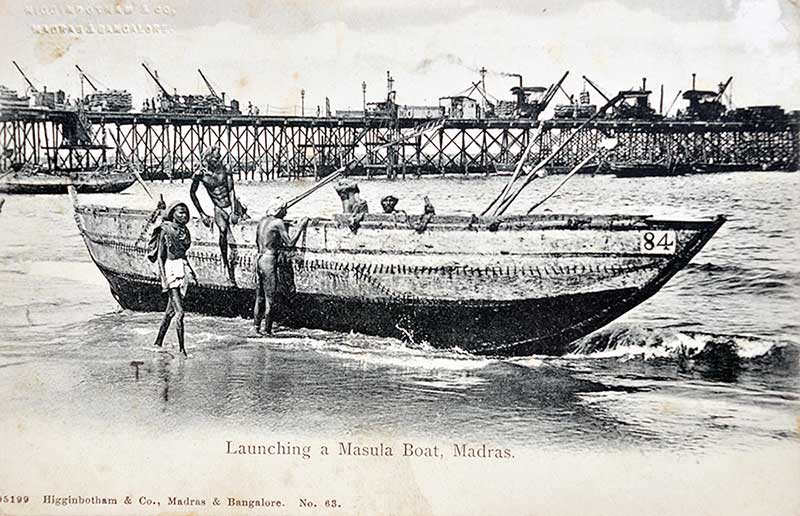
A 1899 postcard with a view of the iron screw pile harbour and masula boats in British-era Madras. The iron pier was a 1000-foot “T” shaped jetty opened in 1861, jutting into the sea. Unlike the natural harbours of Bombay and Calcutta, Madras did not have a natural harbour. This made shipping extremely difficult due to high waves and rough seas. The iron pier served as a rudimentary harbour before permanent breakwaters were constructed in the 1860s.
The Madras Screw-Pile Iron Harbour was one of the earliest attempts by the British to improve maritime trade along the exposed Coromandel Coast. Before the construction of the Madras Port, large sailing ships and steamers had to anchor offshore in the deep sea because they could not safely approach the beach. To overcome this challenge, the British built a remarkable screw-pile iron pier during the mid-19th century, supported by cast-iron piles screwed deep into the seabed. Equipped with railway tracks and cargo-handling facilities, the pier greatly improved the loading and unloading of cargo and passengers. Although rough seas and seasonal storms continued to test the pier’s strength. It marked an important milestone in the evolution of Madras into one of British India’s leading commercial ports.
Working alongside were the famous masula boats, which became the lifeline of Madras Harbour for centuries. These strong surf boats were specially designed to withstand the pounding waves of the sea. Primarily to ferry passengers, mail, and cargo safely between ships anchored offshore and the sandy beach. Long before the construction of enclosed harbour facilities, the Masula boat was indispensable to the city’s maritime trade and remained an iconic symbol of Madras beach. Click image to enlarge.
Did you know — masula boat’s planks were stitched together with coconut coir rope instead of iron nails. This allowed the boats to absorb the impact of powerful surf, making them ideal for carrying passengers and cargo.