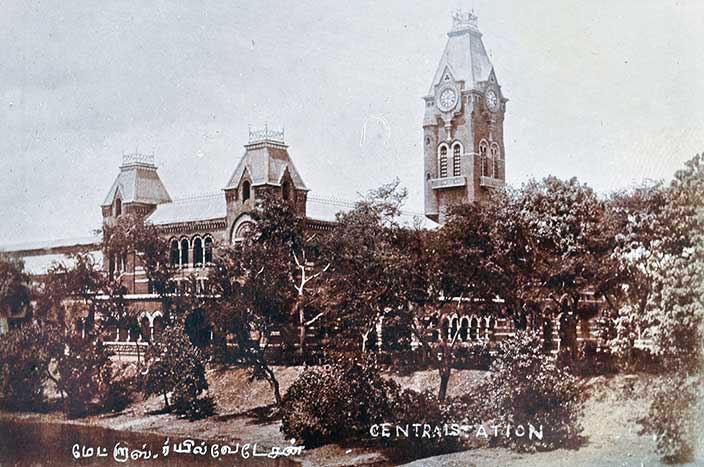
Madras Central Station Beside the Buckingham Canal, 1900 Photo
A 1900 photograph with a view of the Madras Central Railway Station and a partial view of the Buckingham Canal. The historic Madras Central Station (Puratchi Thalaivar Dr. M.G. Ramachandran Central Railway Station) stands with its majestic clock tower beside the Buckingham Canal flowing in the foreground. Long before modern highways and flyovers transformed Madras (Chennai), this man-made canal was an important transport artery, carrying boats laden with rice, salt, firewood, and other goods along India’s Coromandel Coast.
The Buckingham Canal, completed in stages during the British era, stretched for hundreds of kilometres along the east coast. Before road transport became dominant, it served as a vital inland waterway linking Madras with coastal towns to the north and south. Boats frequently passed close to the station.
Opened in 1873, Madras Central Station quickly became the principal railway gateway to southern India. Designed by architect George Harding and later enlarged by Robert Fellowes Chisholm, the station’s distinctive clock tower and arched façade became one of the city’s most iconic landmarks.
This photograph preserves a quieter era when steam trains, canal boats, and colonial architecture together defined the landscape of old Madras. Today, Chennai Central remains one of India’s busiest railway stations, while sections of the Buckingham Canal survive as reminders of the city’s forgotten transport heritage. Click image to enlarge.
Did you know – the Buckingham Canal extends for nearly 800 km, making it one of India’s longest man-made canals.