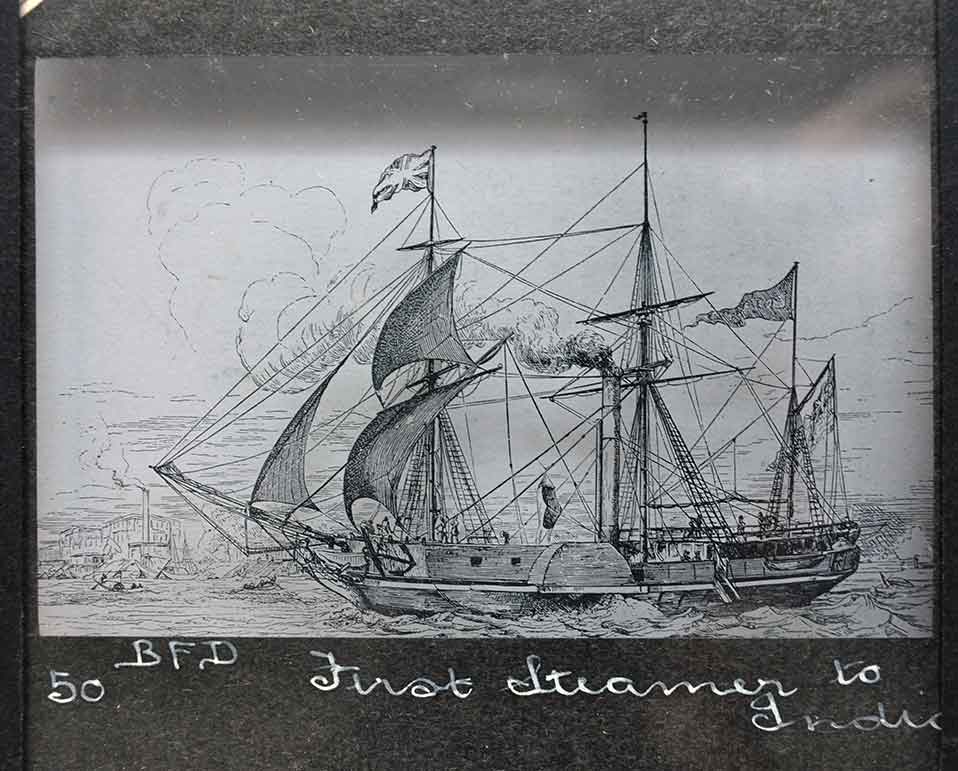
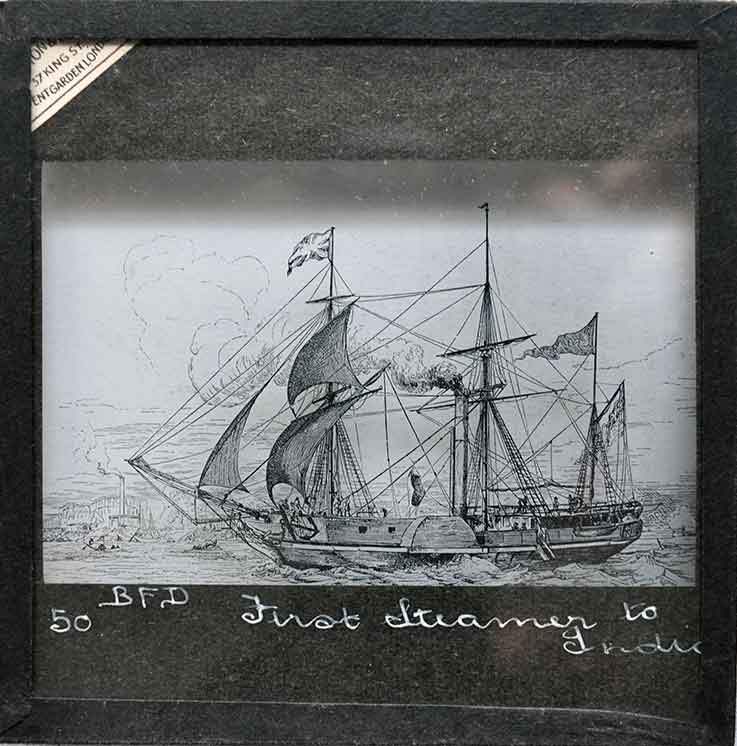
The First Steamship To Sail From England To India, 1890 Glass Slide Photo
A rare 1890 glass slide photograph shows an old sketch of the historic steamship SS Enterprise, widely recognized as the first steamer to sail from England to India successfully in 1825. This voyage marked a turning point in maritime history, signaling the gradual end of the age of sail and the beginning of steam-powered global trade.
Before the advent of steam propulsion, ocean-going vessels relied entirely on sails and wind patterns. Long-distance travel between England and India could take months, with ships dependent on unpredictable weather, currents, and tides. Steam power changed that equation.
The practical use of steam to propel boats began in the late 18th century. American engineer Robert Fulton became a pioneer of commercial steamboat navigation when he launched the Clermont in 1807. Fulton believed steam-powered vessels would hold immense commercial and military value — particularly for British trade interests in India.
As early as 1812, proposals were discussed to introduce steam navigation to India. The rivers of Bengal, especially the Hooghly, posed navigational challenges due to shifting currents and tidal influences. Steam technology promised faster, more reliable transport, independent of wind conditions, a major advantage for administration and commerce under the East India Company.
In 1823, a steam navigation company was formed in England with financial backing from European merchants based in Calcutta. The company commissioned the construction of the Enterprise (pictured), a 60-horsepower vessel designed for long-distance travel.
In 1825, the Enterprise embarked on its groundbreaking voyage from England to India, rounding the Cape of Good Hope before arriving in Calcutta (Kolkata) later that year. Although auxiliary sails were still used during parts of the journey, the voyage demonstrated that steam navigation across oceans was viable.
This achievement laid the foundation for regular steamship services between England and India, revolutionizing communication, trade, and governance across the British Empire.
The introduction of steamships dramatically reduced travel time and increased reliability. Over the decades, improvements in engine design, fuel efficiency, and hull construction further enhanced maritime transport.
A major milestone came with the opening of the Suez Canal in 1869. The canal eliminated the need to sail around Africa, cutting the journey between England and India by thousands of miles. This reduced both travel time and operational costs.
The Enterprise voyage occurred during a transformative era when steam power was reshaping transportation worldwide, from steamships and riverboats to railways and experimental road vehicles. What began as a technological experiment soon evolved into a global maritime revolution.
This 1890 glass slide sketch stands as a reminder of this pivotal moment in history, when steam power first bridged the vast distance between England and India, forever altering global trade and travel. Click image to enlarge.
Did you know – this attempt did not bring much financial success to the British investors. Nevertheless, the voyage certainly took a permanent position in the history of steam navigation. Being the first steamship that came to India from England.