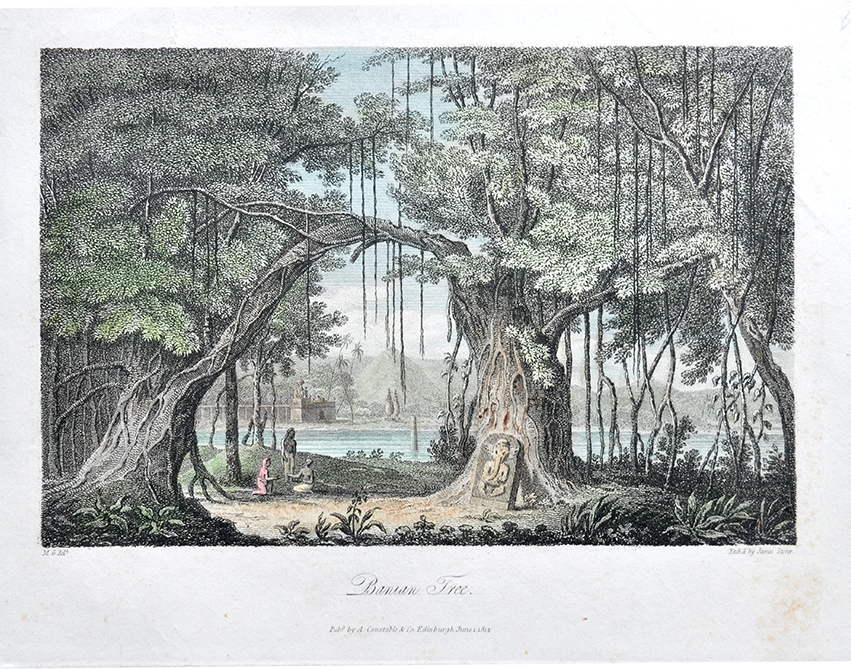
Sion And Its Famous Banyan Tree, Bombay, 1812 print
A rare 1812 hand coloured engraving of the famous Banian (Banyan) Tree at Sion, Bombay (Mumbai) in the British era. The print records a scene Maria Graham encountered during her stay in Bombay in 1809–1810. The beautiful scene was drawn by Graham, the pioneering British travel writer, artist, and illustrator.
She travelled extensively in India, visiting places including Bombay, Madras and Calcutta. Her illustrated observations provide an unusually personal record of the people, architecture, landscapes and customs she encountered. Maria Graham’s excursion to Sion took her through a countryside that she compared to an English park. It was there that she encountered the magnificent banyan tree for the first time, carefully recording its religious significance, noting that banyan trees were regarded as sacred and were commonly associated with Hindu temples.
She described people walking around the tree with folded hands as a gesture of reverence. Flowers and coloured powders were placed near it, and sculpted stones representing Hindu deities could be found at its base.
Nearby, Sion Fort stood on a small conical hill overlooking the route between Bombay and Salsette, giving the area both scenic and strategic importance. Graham also observed the causeway, or vellard, connecting Bombay with Salsette; the work began in 1797 and was completed in 1805 under Governor Jonathan Duncan. Together, her written account and drawings preserve a vivid picture of Bombay at the time of reclamation, and the urban transformation that would reshape the city.
Did you know- in Maria Graham’s time, Sion marked an important point at the northern end of Bombay Island, facing Salsette, which was then a separate island.