Climbing The Coconut Tree To Draw Toddy In Old Bombay, 1834 Print
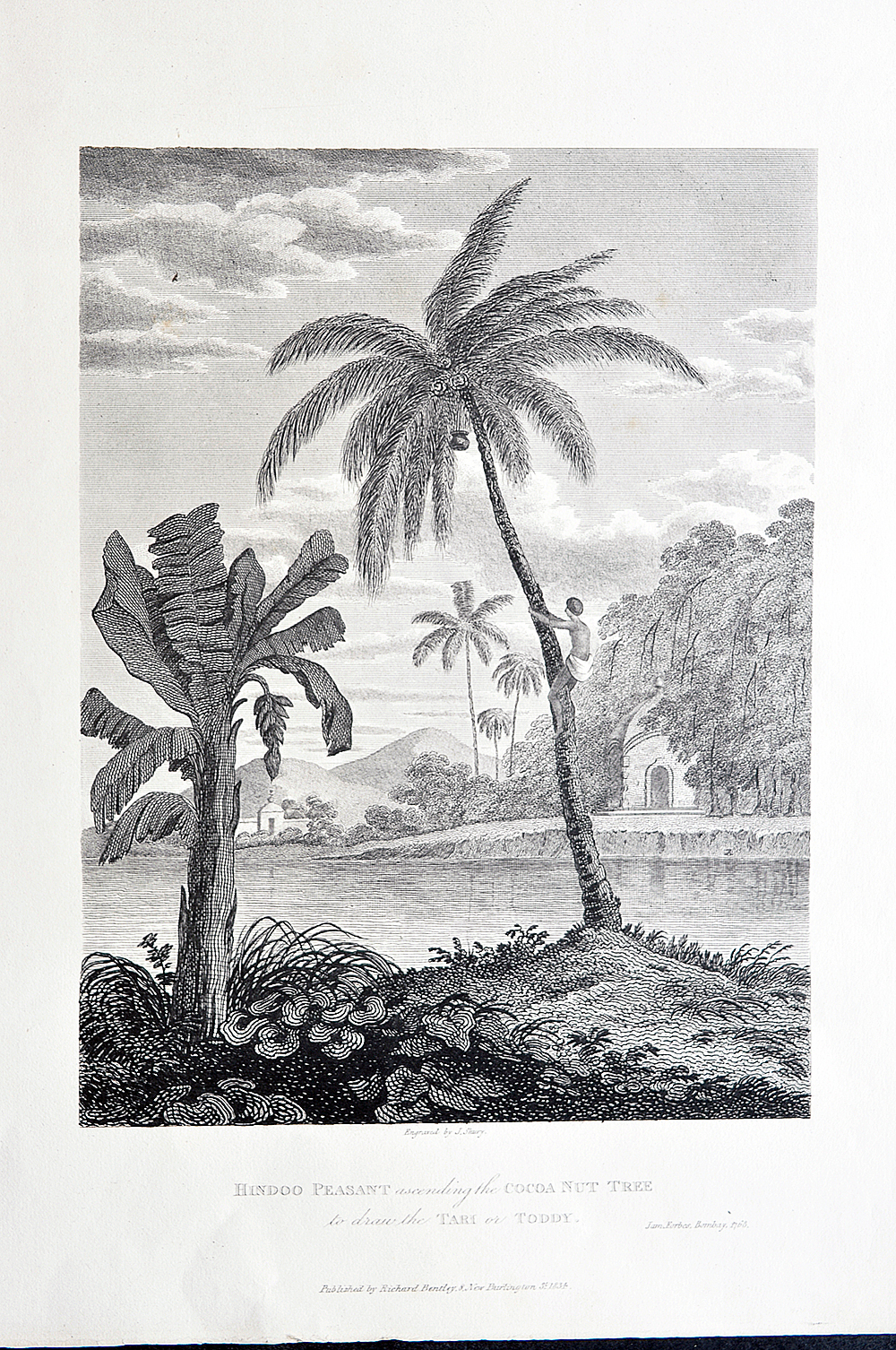
Long before Bombay was developed, the landscape of old Bombay was dominated by coconut groves, fishing villages, rice fields, and dense forests. This fascinating 1834 print, based on an original drawing by the British artist James Forbes from 1768 and later engraved by J. Shury, captures a remarkable everyday scene of the time. The toddy tapper skillfully climbs a tall coconut palm to collect the sweet sap.
Titled “Hindoo Peasant Ascending the Cocoa Nut Tree to Draw the Tari or Toddy.” The tapper is very likely a Bhandari, a community traditionally associated with farming, coconut cultivation, and toddy tapping. Their agility, using little more than a rope and years of experience, was once a familiar sight across the seven islands of Bombay. The city that would eventually emerge to become a modern metropolis.
In the eighteenth century, the Bhandaris and the Kolis were regarded as among the earliest inhabitants of Bombay. While the Kolis earned their livelihood from fishing in the surrounding sea. The Bhandaris cultivated the fertile land; coconut palms and date trees stretched across the landscape, alongside salt pans, orchards, vegetable gardens, and paddy fields. Dense forests sheltered wildlife including tigers, leopards, wolves, hyenas, and foxes. The reclamation of some land from the sea and the construction of causeways by the Portuguese had reduced the seven islands to four by the time the British acquired them. Click image to enlarge.
Did you know – following the marriage of King Charles II of England to the Portuguese princess Catherine of Braganza in 1661, the islands were transferred to the English Crown as part of her dowry before being leased to the East India Company.