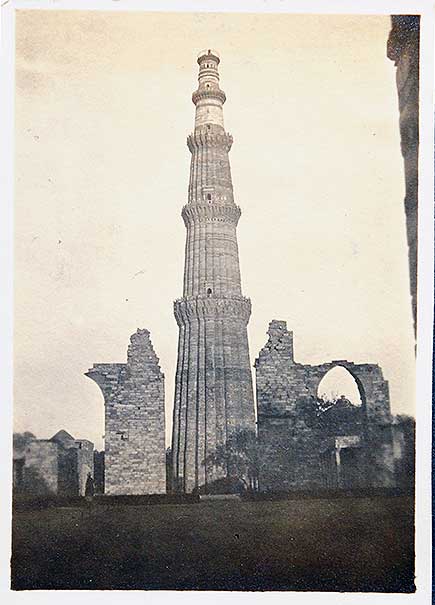
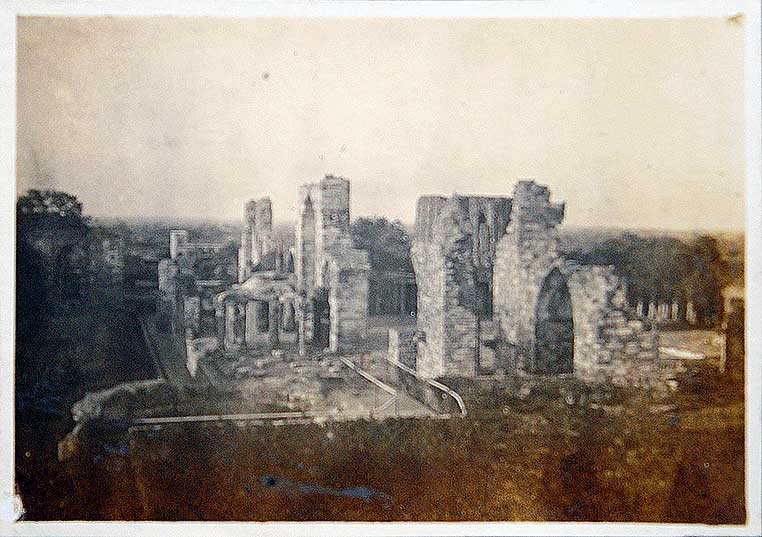
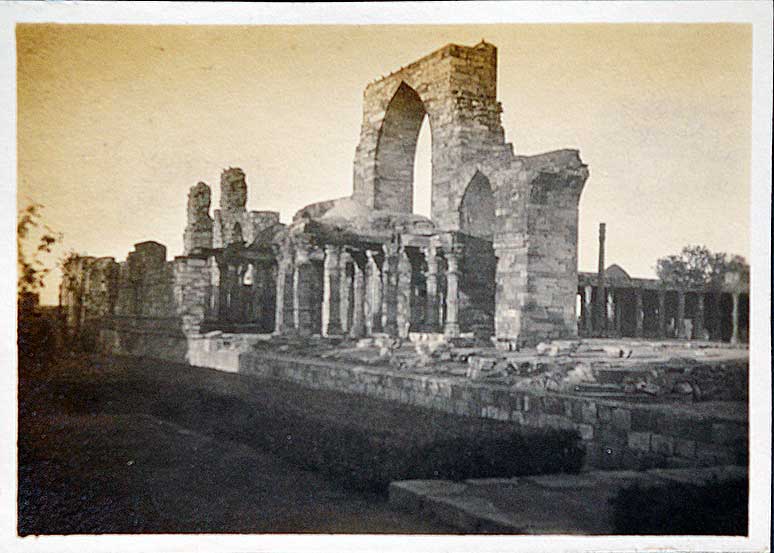
Qutub Minar & Complex, Delhi’s Iconic Landmark, 3 Photos 1900

Three 1900 photographs show Delhi’s iconic landmark, Qutub Minar, and the Qutb Complex. Rising majestically above Delhi’s skyline, the Qutub Minar is one of India’s most celebrated medieval monuments and a remarkable example of early Indo-Islamic architecture. Construction of the towering minaret began in 1199 under Qutb-ud-din Aibak, founder of the Delhi Sultanate, shortly after the defeat of the Rajputs and the establishment of Muslim rule in northern India.
His successor, Shams-ud-din Iltutmish, added further storeys, while the upper sections were later restored and rebuilt by Firoz Shah Tughlaq after damage caused by lightning. Its construction is a combination of both bricks and stone; the main core of the 73-meter-high tower is built using bricks, while the exterior facing is made of finely carved stone. The specific materials vary by section:
The lower three storeys are constructed using red sandstone.
The top two storeys are crafted extensively using a mix of marble and sandstone.
With intricate bands of Quranic inscriptions and geometric carvings, the Qutub Minar remains one of the tallest brick minarets in the world. Its design reflects a fascinating blend of Persian inspiration and local Indian craftsmanship.
The surrounding Qutb Complex is equally rich in history, representing layers of Delhi’s medieval past. This UNESCO World Heritage Site includes the Quwwat-ul-Islam Mosque, regarded as one of the earliest surviving mosques in India. The complex also houses the famed Iron Pillar of Delhi, a metallurgical marvel dating back to the Gupta period that has resisted corrosion for over 1,600 years. Today, the Qutub Complex stands as one of Delhi’s most visited heritage attractions.
Did you know : the unfinished Alai Minar, situated in the vicinity, was conceived by Alauddin Khilji as an ambitious tower meant to surpass the Qutub Minar itself.