Bangalore Council Hall, Landmark of Civic History, 1940 Postcard

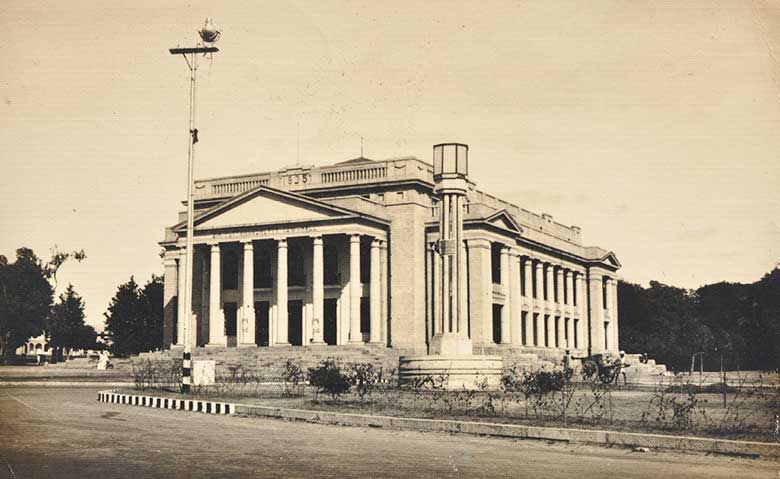
Historic photograph of Bangalore Council Hall (Sir Puttanna Chetty Town Hall) in Bengaluru showing the neoclassical columns and civic architecture near Cubbon Park.

A 1940 postcard shows the Bangalore Council Hall, which was a Landmark of Civic History. The back shows a letter written by one Mr. Nagarwalla to his mother in 1955.

The Council Hall, popularly known today as Sir Puttanna Chetty Town Hall, is one of the most historically significant civic buildings in Bangalore. Built in 1935, the building is located at the entrance of Cubbon Park. It served as the seat of municipal administration before later evolving into a prominent public hall used for cultural events, political meetings, and civic gatherings.

The growing city required a larger and more dignified venue for civic meetings. At that time, Bengaluru was governed by the Bangalore City Municipality. The architecture of the Bangalore Council Hall reflects strong neoclassical influences, a style widely used for civic buildings during the British colonial era.

Its placement near Cubbon Park further enhanced its visual prominence, making it one of the most recognizable landmarks of colonial-era Bangalore.

Over time, the Council Hall ceased to function as the primary municipal chamber. In recognition of Sir Puttanna Chetty’s contributions, the building was renamed Sir Puttanna Chetty Town Hall.

Sir Puttanna Chetty was a respected businessman, philanthropist, and former chairman of the Bangalore Municipality. Who played a major role in the city’s civic development during the late nineteenth and early twentieth centuries. The renaming honored his contributions to public welfare and urban growth in Bangalore.

Today, the Town Hall serves as one of Bengaluru’s most important venues for public gatherings and cultural programs. Because of its central location and historical significance, the hall continues to function as a focal point for civic engagement in the city.

Did you know – the hall’s seating capacity was reduced from 1,038 to 810. Making room for better-designed, improved seating and stage layout.