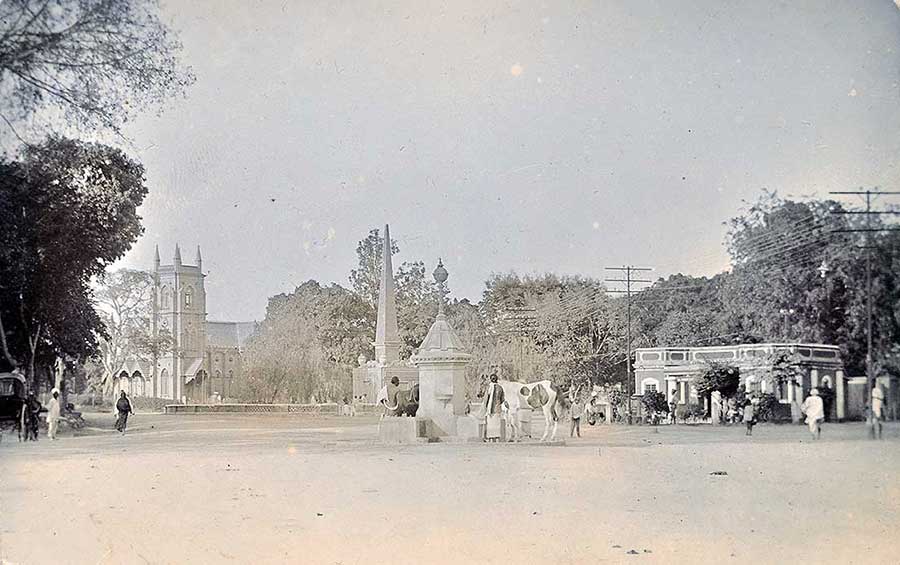

Bhendi Bazaar: A Glimpse Into Bombay’s Early Urban Expansion, 1890 Photo
A 1890 photograph of Bhendi Bazaar offers a glimpse into Bombay’s (Mumbai) early expansion during the late 19th century. By this time, the city had already undergone a major transformation. The reclamation of the seven original islands that began in the 18th century was largely completed by the 1830s.
During the British period, the East India Company actively encouraged traders, artisans, and skilled workers to settle near Fort George. As the Fort area evolved into a powerful financial district, the settlement took on a clear divide:
-
European trading houses and offices dominated the southern precincts,
-
while Indian merchants, artisans, and laborers established their homes and workshops to the north.
To accommodate the growing number of single male workers arriving in the city, the British designated a cluster of residential spaces in what would later become Bhendi Bazaar. These structures were built as chawls, long, narrow, multi-storey dormitory-style buildings with shared corridors and common facilities. Over time, as workers brought in their families, Bhendi Bazaar evolved from a male-dominated lodging zone into a dense, culturally vibrant residential district.
As the decades progressed, many of these buildings were sold to private landlords, who rented out rooms and small tenements. Consequently, Bhendi Bazaar had firmly established itself as one of Bombay’s busiest commercial centers. Its narrow lanes bustled with textile shops, hardware stores, eateries, wholesale outlets, and family-run businesses. The area’s commercial energy was reinforced by its proximity to other iconic markets:
-
Crawford Market (now Mahatma Jyotiba Phule Market),
-
Chor Bazaar, famous for antiques and curios
-
Null Bazaar
And several other trading pockets that together formed the commercial heart of the city at the time. Click Image To Enlarge
Did you know – that the origin of the name Bhendi is not clear. It is said to have originated when the British referred to the place as “behind the bazaar” (meaning behind Crawford Market), which was then, over the years, corrupted to “Bhendi Bazaar.” Another likely theory was that it referred to the okra (Bhindi) farms that once existed there.
Past posts – Bhageerathi, The Wife Of Raja Ravi Varma, 1870 Photo.,
.