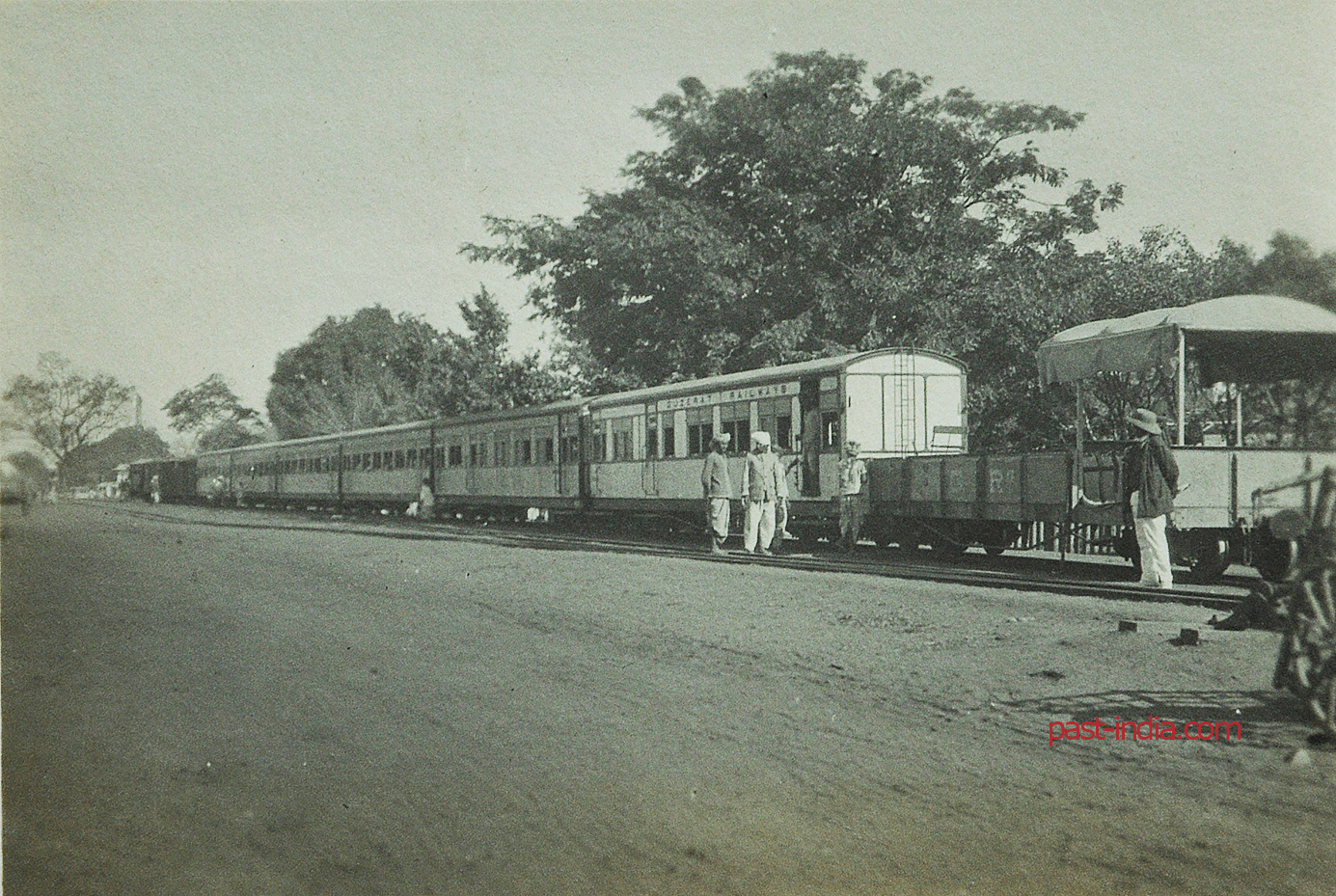
Forgotten Guzerat Railways, Gujarat’s Historic Railway, 1912 Photo
A 1912 photo captures a Guzerat (Gujarat) Railway train likely waiting at a station. The Guzerat Railway Company was an important part of Gujarat’s railway heritage. It operated a network of narrow-gauge lines that helped connect remote towns and rural communities during the early 20th century. Incorporated in 1911 and managed by Killick, Nixon & Company, the railway system comprised the Godhra–Lunavada Railway, the Nadiad–Kapadvanj Railway, and the Champaner–Shivrajpur–Pani Light Railway. Spanning approximately 135 kilometres, these lines played a significant role in moving passengers, agricultural produce, and local goods across the region, contributing to economic growth during the colonial era.
One of the most fascinating chapters in the network’s history was the Champaner–Shivrajpur–Pani line, which was originally planned to serve manganese mines. Before steam locomotives arrived, part of the route reportedly operated as a bullock-drawn rail, an unusual experiment in Indian railway history. The Godhra–Lunavada section extended 41 kilometres into eastern Gujarat, while the Champaner–Shivrajpur–Pani route covered 49 kilometres. In 1922, the entire Guzerat Railways network was absorbed by the Bombay, Baroda and Central India Railway (BB&CI Railway), and later became part of the Western Railway system in 1951, ensuring its legacy remained woven into the story of India’s railway development. Click image to enlarge.
Did you know – the railway used a narrow gauge of just 2 ft 6 in (762 mm), much smaller than India’s broad-gauge lines.