
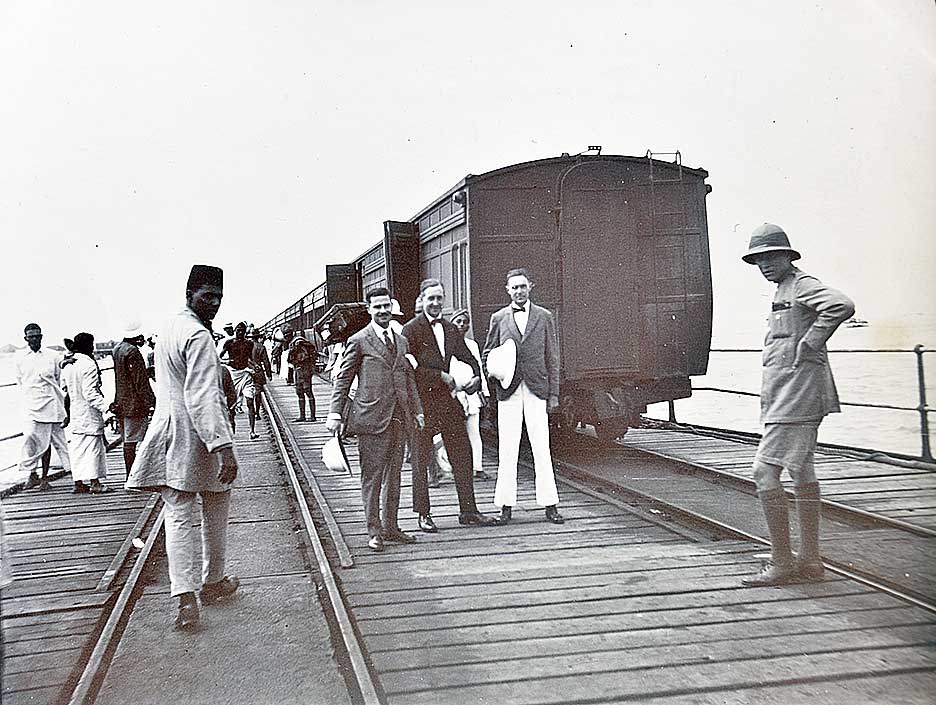
Train Halts On The Pamban Bridge For Ship To Pass, 1920 Photo
A rare 1920 photo of the Boat Mail Train halts on the Pamban Bridge, probably to allow a ship to pass. Passengers, including British officials, have disembarked from the halted train on the bridge. Likely waiting for a ship to pass beneath the Scherzer rolling lift span bridge. It may also have been the occasion marking the introduction of a new train service.
Shown here are British officials, Indian railway personnel, and passengers standing beside a carriage on the Dhanushkodi railway pier, part of the historic Indo–Ceylon transit route. By the early twentieth century, Dhanushkodi had emerged as a vital maritime gateway linking southern India with Ceylon (Sri Lanka).
The railway line, operated by the South Indian Railway Company, connected Madras to Rameswaram Island via the engineering marvel of the Pamban Bridge (opened in 1914). From Rameswaram, the track extended further southeast to Dhanushkodi, where passengers transferred directly to steamers bound for Talaimannar (Ceylon).
The wooden-planked marine track visible in the image formed part of the pier extension, designed to bring railway carriages close to the embarkation point. The presence of British officers in tropical attire, including sun caps, suggests either an inspection visit or official transit took place along the railway route.
During this period, the celebrated “Boat Mail” service enabled seamless travel between India and Ceylon, carrying administrators, military personnel, merchants, and pilgrims. Dhanushkodi flourished as an international port until the catastrophic cyclone of December 1964 destroyed the town and permanently severed the railway line beyond Rameswaram. Click photo to enlarge.
Did you know – that today, Dhanushkodi remains a haunting reminder of a once-thriving maritime and railway junction at the edge of the Indian peninsula.