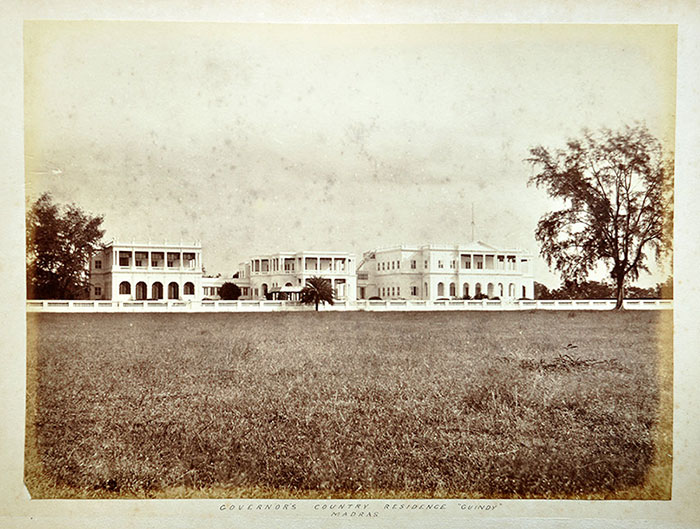
19th-Century View of Guindy Lodge, Now Raj Bhavan, Madras, 1880 Photo
A 19th-century photograph of Guindy Lodge, or the Governor’s Country Residence at Guindy, Madras (Chennai). The photo dates from the 1880s. The elegant white buildings have long verandahs, arched ground-floor openings, and spacious upper-storey galleries. The Residence stands on a vast estate of around 400 acres.
Guindy Lodge is believed to have originated during the governorship of William Langhorne in the early 1670s. After passing through private hands, the government acquired the property in 1821 under Governor Sir Thomas Munro, who recognised the need for a country residence where the Governor could conduct public business away from interruptions. Between 1837 and 1841, Governor Lord Elphinstone oversaw substantial alterations and improvements, and further additions by subsequent Governors gave the residence much of the appearance it had acquired by 1863.
Fort St George, situated close to the coast, was the centre of British administration in Madras and had experienced enemy attacks, including the French capture of the city in 1746. Earlier, the Governor’s Garden House had been destroyed during the French occupation. There is no verified evidence that Guindy Lodge was established specifically as an emergency refuge from a seaborne attack. Its location away from the coastal fort offered a more secluded setting in which the Governor could reside and conduct official business. The Governor could travel from the city to Guindy via Mount Road (Anna Salai).
Did you know – Guindy Lodge remained a country retreat for many years. Following India’s independence, it became Raj Bhavan, the official residence of the Governor of Tamil Nadu.