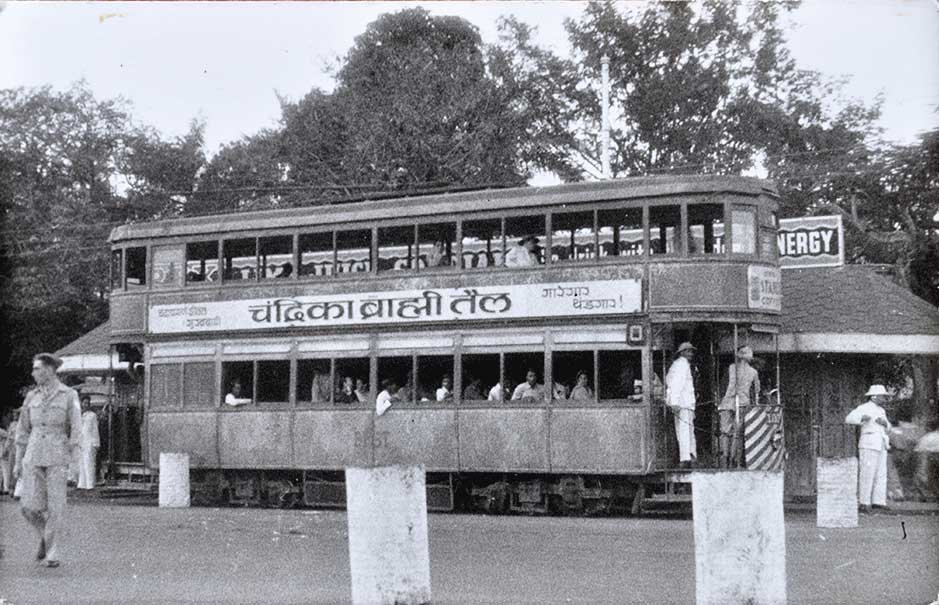
WWII Bombay: American Servicemen & Double-Decker Tram, 1943
A 1943 photograph offers a glimpse of a Bombay (Mumbai) street scene during WWII. The photo captures an American serviceman, several men who appear to be British, locals, and one of the city’s iconic double-decker trams. Bombay was an important Allied port and transport centre during the war.
The tram dominates the scene, its long, two-storey carriage and rows of open windows revealing passengers seated on both upper and lower decks. A prominent advertisement for Chandrika Brahmi Oil, written in Devanagari script, stretches across the carriage side, adding a distinctly local detail amid the international wartime setting.
Along the lower deck, passengers, mainly locals, peer out from the open windows. Passengers who appear to be Europeans sit on the upper deck. Some men stand near the tram’s entrance, while a few others are faintly visible in the background on the left. An American serviceman is walking towards the foreground.
During World War II (1939–1945), British India became a vital Allied military and supply base in Asia. American forces stationed across the China-Burma-India (CBI) theatre supported Chinese Nationalist leader Chiang Kai-shek’s armies with weapons, fuel, food, etc. They also assisted operations against Japanese forces in Burma. By October 1944, the CBI theatre contained approximately 204,000 US Army personnel. Bombay, with its important port and transport connections, formed part of the wider wartime supply network. The Allied victories at Imphal and Kohima in 1944 helped turn the tide against Japan in northeastern India, which helped pave the way towards the recapture of Burma from the Japanese army.
Did you know – Bombay was among the Indian ports used to receive Allied supplies. Cargo arriving by sea still had to travel across the subcontinent to military depots and operational bases.