Coonoor Station: Railway Travel in the Nilgiri Hills, British Era, 1905
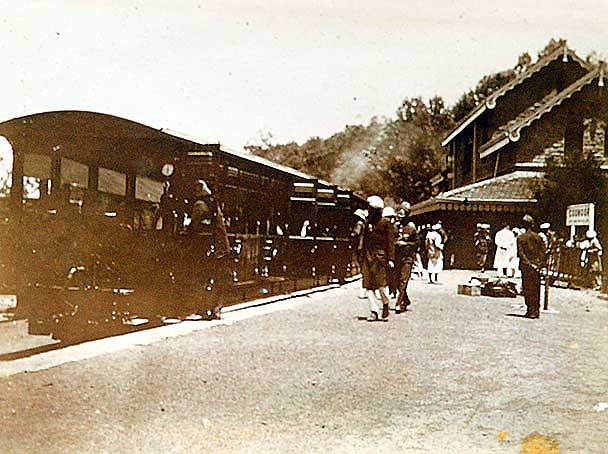
This fascinating 1905 photograph offers a glimpse of the Coonoor Railway Station and the Nilgiri Mountain Railway (NMR) during the British era. The scene captures a steam train standing beside the platform. Coonoor Railway Station, seen here before the First World War, appears almost frozen in time: a steam train, formally dressed travellers, railway personnel, and the distinctive colonial-era station architecture together preserve a fleeting moment from the golden age of Indian hill railways during British India.
Coonoor was an important station on the mountain railway linking the hill country with the plains, and its location amid the wooded slopes made the journey as much a scenic experience as a means of transport.
The photograph records the Nilgiri Mountain Railway at a formative stage of its history. The railway reached Coonoor in 1899, while the extension from Coonoor to Ooty was completed only in 1908. The steep mountain section was an extraordinary feat of railway engineering, using a rack-and-pinion system to help trains negotiate gradients that ordinary railways could not easily overcome.
The Nilgiri Mountain Railway (NMR) is renowned for its exceptionally steep gradients, including the steepest section of railway in Asia. To conquer this challenging mountainous terrain, the railway employs a unique rack-and-pinion system together with specially designed steam locomotives.
Did you know – many of these vintage locomotives originated from the workshops of the Swiss Locomotive and Machine Works (SLM) in Winterthur, Switzerland.