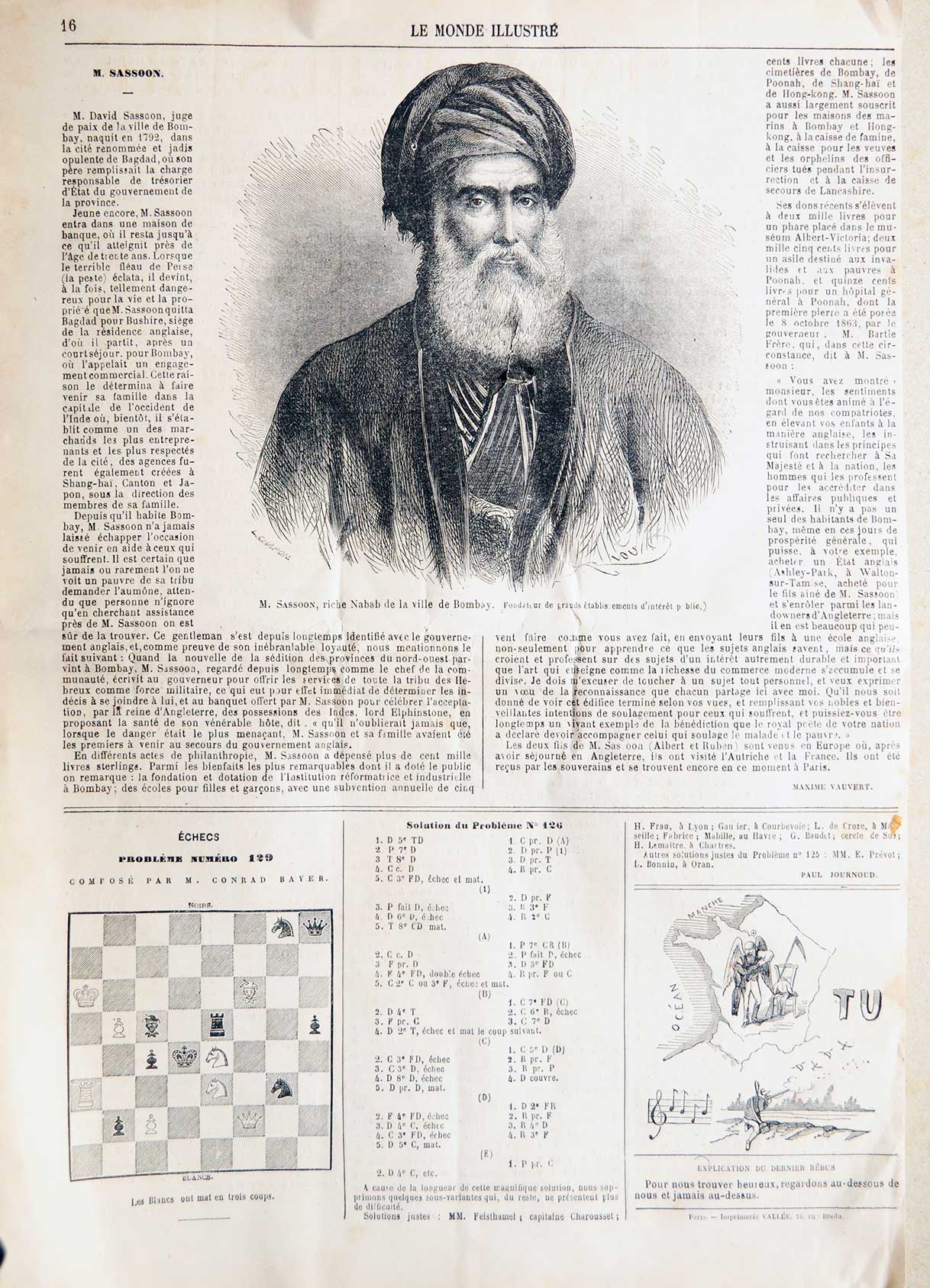
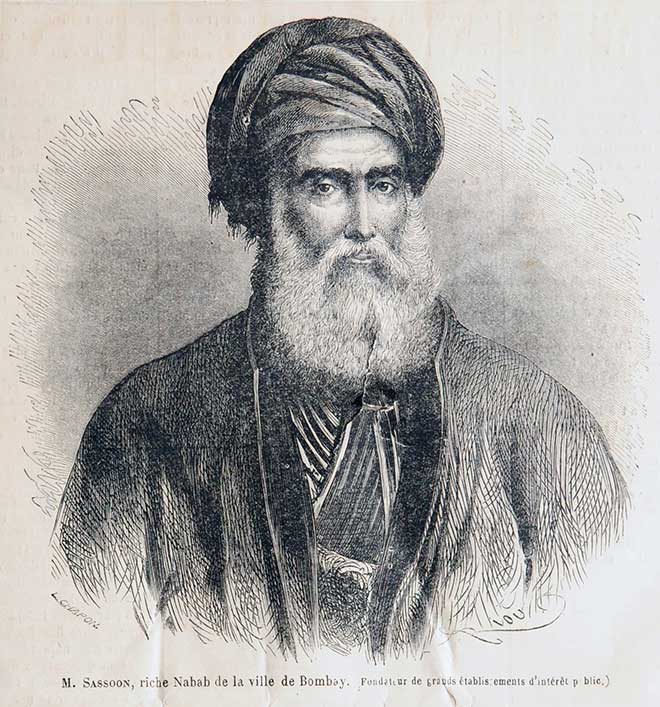
David Sassoon, The Man Who Built Bombay, 1864 Newspaper Page

A rare page from a 1864 French newspaper featuring an article and engraving of Bombay’s (Mumbai) great businessman, David Sassoon. Sasson was a simple turbaned man of Baghdadi Jewish descent. Although looks can be deceptive, he left an indelible mark on the city’s skyline, commerce, and civic life in his lifetime. Sassoon played a key role in shaping Bombay’s financial and industrial landscape. He established the Bank of India and developed Bombay’s first planned industrial suburb in Byculla, which became a blueprint for the city’s industrial expansion, drawing waves of immigrants and shaping its working-class culture.
David Sassoon (1792–1864), arrived in Bombay in the early 1830s after fleeing Jewish persecution in Baghdad. From modest beginnings in a growing colonial port city, he built one of the most influential trading empires in Asia, helping transform Bombay into a major commercial hub of the British Empire.
Born into a prominent Jewish family in Baghdad (Iraq), David Sassoon had served in administrative and financial roles before political instability forced his departure. When he settled in Bombay in 1832, the city was emerging as a vital maritime center. Sassoon recognized its immense potential and established David Sassoon & Co., a trading firm dealing in cotton, silk, yarn, spices, and international commerce across India, China, and the Middle East. His business instincts, global connections, and understanding of maritime trade made him one of Bombay’s wealthiest merchants within a few decades.
Yet David Sassoon’s legacy in Bombay extends far beyond commerce. Unlike many merchants of his era, he reinvested heavily in public institutions and civic infrastructure. His philanthropy contributed to schools, libraries, synagogues, hospitals, and charitable institutions that served Bombay’s diverse communities. Landmarks associated with the Sassoon family—including the David Sassoon Library, Sassoon Docks, and Elphinstone educational institutions. The future generations of the Sassoon family had greatly contributed to the construction of the Gateway of India, the Institute of Science, the clock tower at the Victoria Gardens, the Victoria and Albert Museum, etc.
David Sassoon also played a pivotal role in shaping the city’s multicultural identity. His arrival encouraged other Jewish merchant families from West Asia to settle in Bombay, enriching its cosmopolitan social fabric. In the 19th century, Bombay was a city of traders, shipowners, industrialists, and migrants—and Sassoon stood among its most influential architects.
However, like many great mercantile fortunes of the colonial era, the Sassoon empire was also intertwined with the complexities of imperial trade, including commerce linked to China’s opium markets. This remains a debated part of the family’s history, reflecting the moral contradictions of 19th-century global trade networks. Still, David Sassoon’s impact on Bombay’s urban development and philanthropy remains undeniable.
Today, traces of David Sassoon’s legacy survive across Mumbai—in heritage buildings, docks, libraries, and archival records—offering a reminder of how one refugee merchant helped shape the city’s rise as a global port. Click image to enlarge.
Read more David Sassoon – from Baghdad to Bombay
Did you know – interestingly, despite his vast empire, he never learned English, relying instead on Hebrew-speaking accountants.