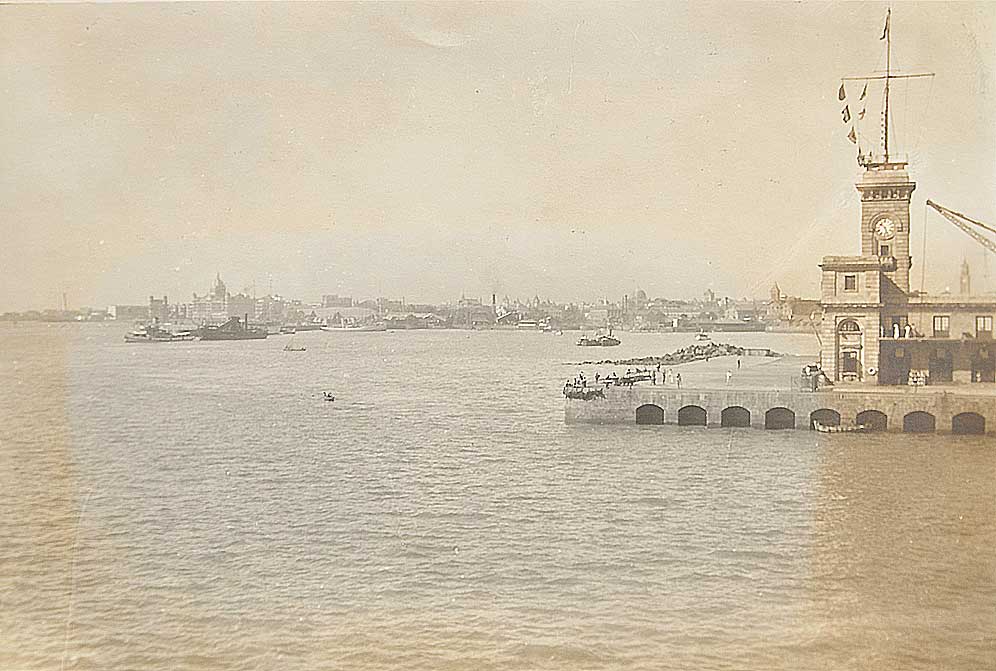
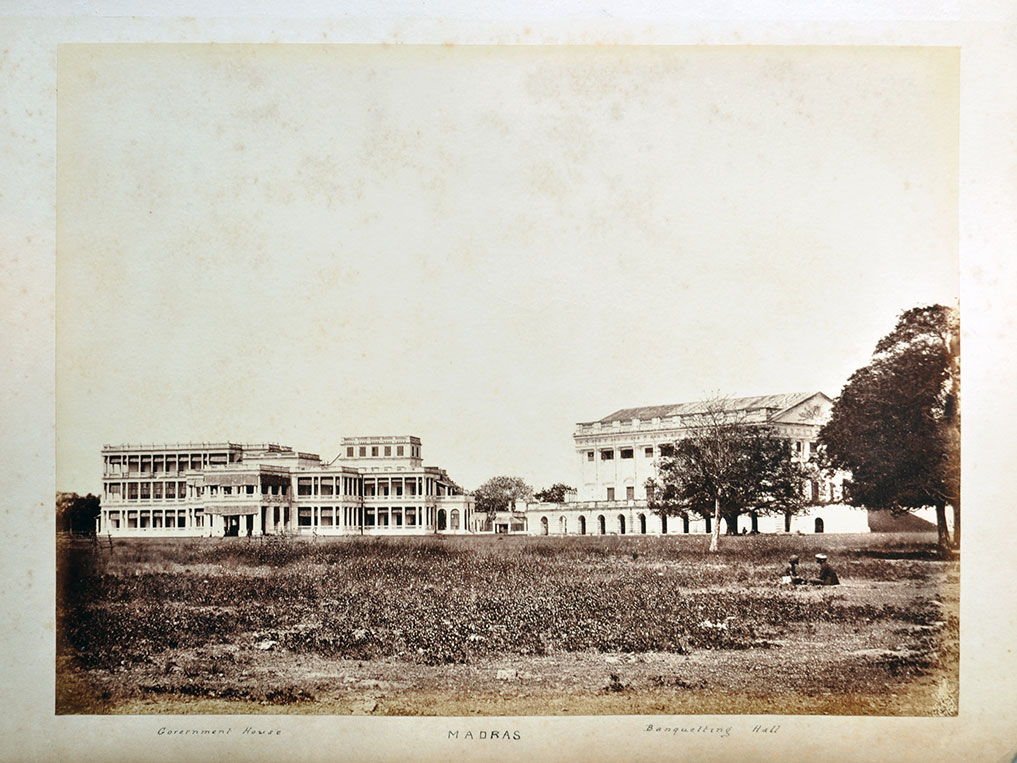
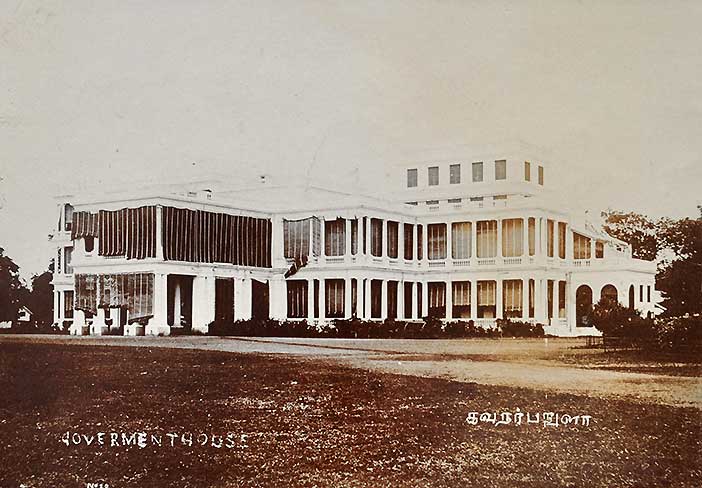
British-era Government House & Banquet Hall, Madras, 2 Photos 1890

One of the photographs is from 1890, featuring the British-era Government House and the Banqueting Hall; the second is from 1900 and shows only the Government House. The Government House stood as the official residence of the British Governor of the Madras Presidency. Occupying a vast riverside estate along the Cooum River near today’s Anna Salai (formerly Mount Road). More than a residence, the sprawling Government Estate formed the administrative and ceremonial heart during the colonial era. A magnificent entrance on the Mount Road side served as the principal ceremonial gateway. Where governors, visiting royalty, and distinguished guests arrived in horse-drawn carriages before entering the estate.
The history of Government House stretches back even further. The estate was acquired in 1753 from the widow of a Portuguese merchant and gradually expanded into the official residence of successive Governors of the Madras Presidency. While Government House served as the Governor’s principal urban residence, the Governor also maintained a quieter country retreat at Guindy. Originally developed as a garden house and later associated with Sir Thomas Munro. Today, it is known as Raj Bhavan, the official residence of the Governor of Tamil Nadu.
Within the Government House Estate stood the magnificent Banqueting Hall, now known as Rajaji Hall. A fine example of Neoclassical architecture in Madras. Designed by East India Company astronomer and engineer John Goldingham and completed in 1802, the hall was built to celebrate the British Indian victory over Tipu Sultan in the 4th Anglo-Mysore War. Its central hall hosted state banquets, investitures, receptions, and grand balls attended by colonial officials and visiting dignitaries. Following India’s independence, the building was renamed Rajaji Hall in 1948 in honour of C. Rajagopalachari (Rajaji), the first Indian Governor-General of independent India. Click image to enlarge.
Did you know – the grand Government House building was demolished in 2008, bringing an end to one of the city’s most significant colonial-era landmarks.