Delhi’s Qutub Minar in Ruins During the 19th Century, 1810 Print
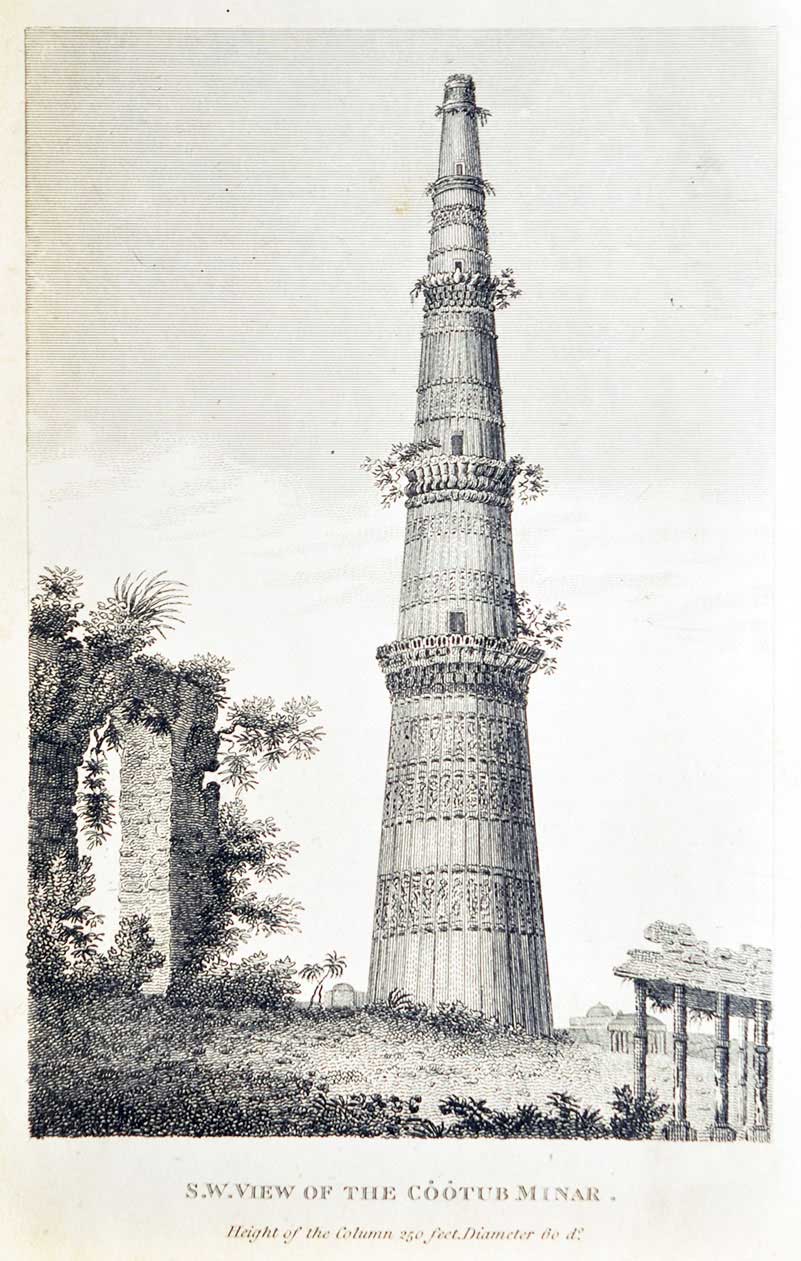
This unusual and rare 1810 engraved print captures Delhi’s Qutub Minar in ruins during the early 19th century. The magnificent medieval tower appears surrounded by neglect, crumbling masonry, and what seem to be wild plants growing across its outer wall. Titled “S.W. View of The Cootub Minar,” the engraving records the monument from the south-west.
Rising to approximately 72.5 metres (238 feet), the Qutub Minar is one of India’s tallest historic brick-and-stone towers and a masterpiece of early Indo-Islamic architecture. Its construction was initiated around 1199 by Qutb-ud-din Aibak, the founder of the Delhi Sultanate. And continued by his successor, Iltutmish, with later additions and repairs undertaken by subsequent rulers. The tower’s distinctive tapering form, projecting balconies, and bands of intricate Arabic inscriptions make it architecturally remarkable. Its fluted lower storeys, built largely of red sandstone, contrast with the lighter stone used in parts of the upper levels.
One possible reason for the deterioration of the Qutub Minar as depicted in this rare historical engraving is the powerful earthquake that struck Delhi in 1803. This damaged the tower and contributed to the necessity for subsequent repairs. During British rule in India in the 19th century, restoration work was undertaken. Including repairs carried out under Major Robert Smith in 1828.
The surrounding Qutub complex is equally rich in history, containing the Quwwat-ul-Islam Mosque and the unfinished Alai Minar. The celebrated Iron Pillar standing nearby dates back many centuries before the tower itself. Today, the Qutub Minar and its associated monuments form a UNESCO World Heritage Site, recognised for their outstanding architectural and historical significance.
Did you know – Major Robert Smith famously added a cupola to the summit in 1828, but it was removed in 1848 and placed on the ground nearby. It is now known as Smith’s Folly.