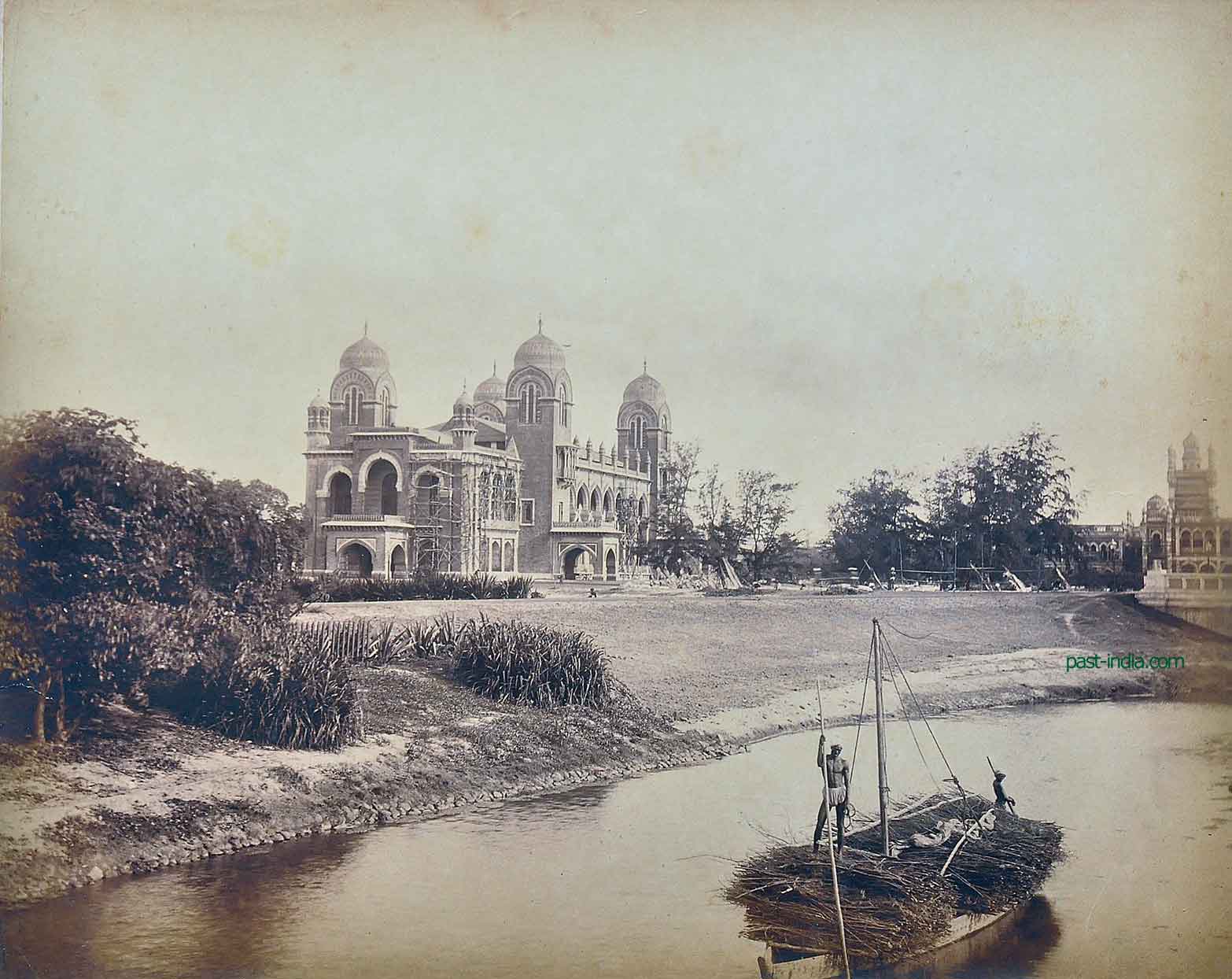
Senate House Across The Cooum Madras, 1879 Photo

This 1879 old photograph shows the Senate House. From across the Cooum River in Madras (now Chennai). The beautiful waterway shown in the foreground is a small branch of the famous Cooum River. Running parallelly to the Senate House and the Chepauk Palace from the back. The Palace is visible near the right edge of the picture. The front side of both these buildings is Marina Beach and Promenade.
See earlier post Marina & Senate House Madras 1900s, 3 Old Postcards.
The Senate House building seems to have been newly completed. The scaffolding and presumably other construction materials can be seen strewn around. A small number of men apparently construction workers are also vaguely visible. See the close-up for a slightly clearer picture.
The Senate House was built on the site of the Nawab’s artillery park. It was to be the headquarters of the University of Madras. Considered by many architects as the finest example of Indo-Saracenic design in India. Robert Chisholm participated in a competition in 1864 to design two buildings.
One was the city’s first college – The Presidency College. And the other is the University of Madras’ administration and examination hall – The Senate House. He submitted the prize-winning designs for both. The building with its onion-shaped domes was completed in 1879. The domes may have been inspired by the Taj Mahal or the Gol Gumbaz of Bijapur. See the serene Cooum River in the foreground with a boat carrying a cargo of reeds and men. An unimaginable sight today. Click on the photo for better view.
See post Chepauk Palace Chennai From The River, Old Photo 1880.
Did you know- that Robert Chisholm began a glorious 30 years and more of Chisholm-created Indo-Saracenic buildings in Madras.
From the collection- Vintage Raja Ravi Varma “Saraswati” Oleograph
The images are of the actual items from my collection. And Not a photocopy, pirated, reproduced, stock photos, or taken from other sources.